
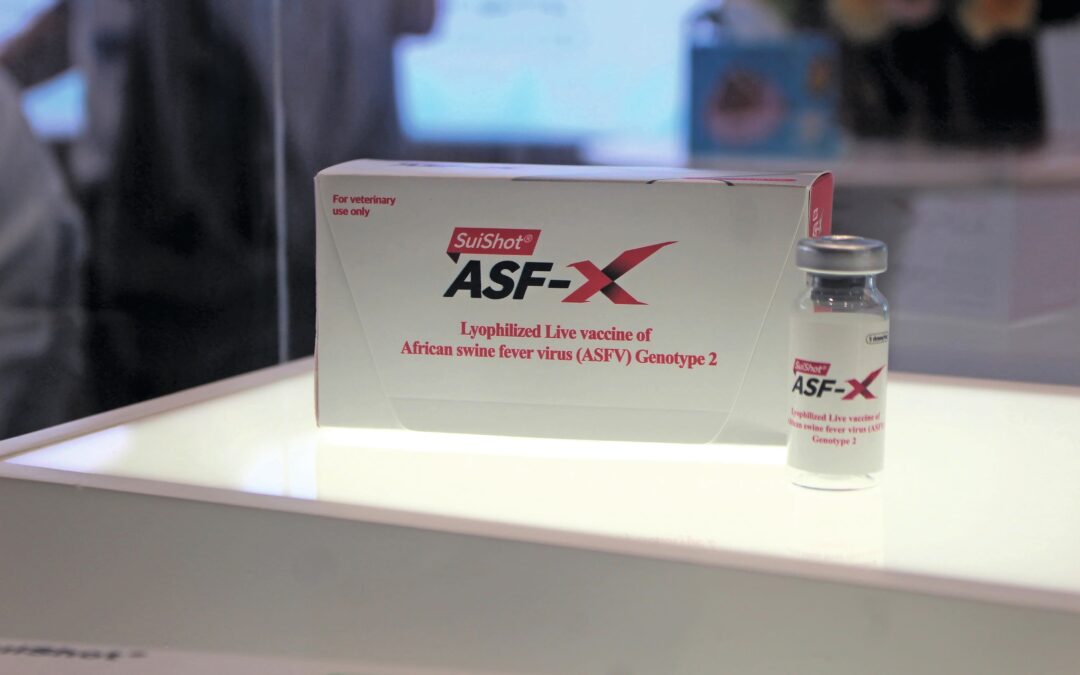
A vaccine of South Korean origin against African Swine Fever (ASF) is soon to hit the market in the Philippines and Vietnam. In April 2026, animal health company CAVAC received export permission for its novel vaccine called Suishot ASF-X in South Korea.
Marketing permission in both countries is expected to be granted over the next few months, and the registration process is now under way, explained the company’s CEO Dr Jason Lee and Dr Sungsik Yoo, the head of the ASF project at CAVAC. The company shared this message at the 28th edition of the International Pig Veterinary Society (IPVS) congress, held June 15-18 in Ho Chi Minh City, Vietnam.
Protection against genotype 2
The vaccine is developed to provide protection against genotype 2 of the virus, and in its official communication brochure the vaccine is said to ‘reduce clinical signs including mortality and provide robust protection’.
The vaccine is promoted as a two-shot 2 ml intramuscular injection and can be administered to any type of animal, i.e. piglets, gilts or sows, even though the suggested administration schedule for each animal type is slightly different.
The vaccine is a ‘cell-adapted live vaccine’, called ASFv-MEC-01. In doing so, the company has taken a different road than most other vaccine development initiatives, i.e. it is not building on basic research carried out at the Agricultural Research Service (ARS) of the US Department of Agriculture (USDA). Instead, the company chose to work with a naturally occurring attenuated version of the virus that was observed to circulate in wild boar in South Korea.
The vaccine is being introduced to the market not only as a vaccine for domestic animals, but also as a ‘bait vaccine’, so it could be used for virus control in the wild boar population. The company has experience with making bait vaccines as it has produced similar products for the control of both Classical Swine Fever (CSF) and rabies.
Vietnam and the Philippines
The company has opted for markets like Vietnam and the Philippines as that is where there is an urgent need to get the virus under control. Its home market South Korea – which has also been affected by ASF since 2019 – follows a national control policy that is more in line with the EU approach of zero tolerance. A vaccination strategy in South Korea is therefore not in line with the market needs.
At a satellite symposium at IPVS, CAVAC’s employees emphasised the product’s safety, efficacy and genetic stability. Field trials have been carried out at farms in Vietnam near both Ho Chi Minh City (piglets, gestating sows and newborn piglets) as well as Hanoi (piglets and gilts). When pregnant sows were vaccinated, outcomes reported a 100% seroconversion amongst neonatal piglets after post-colostrum ingestion.
In trials with six-week-old pigs carried out in Vietnam, no significant changes in body temperature or abnormal clinical signs were observed following both prime and booster vaccinations. In addition, all vaccinated animals seroconverted 1 week after the booster vaccination. Last but not least, all vaccinated animals were observed to survive after a challenge with ASF genotype II, whereas in the control group all animals had died.
The company stated that the vaccine has been developed in alignment with guidelines of the World Organisation of Animal Health (WOAH).
Other ASF vaccine projects
Once on the international market, it means that after various attempts from Vietnam, now also a player from South Korea will enter with an ASF vaccine. At the IPVS Congress, also MSD Animal Health (Merck in the USA) shared updates about their development towards an ASF vaccine – and so did Komipharm, another South Korean animal health company. Since 2023, the Vietnamese company AVAC has been promoting its vaccine for use in piglets in various markets in South East Asia.