
Shamonda-like virus (SHLV) (or Shamonda-like virus, strain DE/2026) is an arbovirus belonging to the Peribunyaviridae family. It is a novel and previously uncharacterized Orthobunyavirus of the Simbu serogroup. It is transmitted by midges of the genus Culicoides and is closely related to Schmallenberg virus.
Although the original Shamonda virus was isolated in Nigeria in the 1960s, a genetically divergent variant emerged in Central Europe (Germany, Switzerland, France, and the Netherlands).
It primarily affects cattle; it can also affect small ruminants (sheep, goats), and suspected cases in horses have been investigated. It is transmitted by the bite of midges of the genus Culicoides (tiny mosquitoes). It is not transmitted by direct animal-to-animal contact. It is closely related to other orthobunyaviruses of the Simbu serogroup, such as Schmallenberg virus (SBV) and Akabane virus (AKAV).
Acute infection in adults is characterized by:
- Fever
- Drastic drop in milk production
- Diarrhea and lethargy
Infection in pregnant females, unlike other infections, has a teratogenic effect:
- If a pregnant cow is infected for the first time during gestation, the virus crosses the placenta.
- This causes optional abortions or the birth of calves with arthrogryposis-hydranencephaly syndrome (AHS), similar to Schmallenberg virus (SBV): bone malformations (rigid/deformed limbs) and severe malformations of the brain and spinal cord. Unlike Schmallenberg virus (SBV), it causes similar congenital malformations (rigid joint flexion, scoliosis, cranial deformity), although the severity of neurological brain damage (hydranencephaly) varies depending on the exact timing of the viremia.
- Currently, there is no specific vaccine or antiviral treatment for this outbreak. Control measures focus on the use of repellents, managing barns during peak activity hours of the vector insects (Culicoides), and epidemiological surveillance on livestock farms.
Ortobunyaviruses readily exchange genetic segments when two viruses infect the same host or vector simultaneously. While classical SBV was the first widely characterized European orthobunyavirus of this serogroup, SHLV (type 2026) represents a reassortant variant where the replication machinery (polymerase L) and the capsid (S) are derived from the Shamonda lineage, affecting its evolution and molecular diagnosis by RT-qPCR.
RT-qPCR tests specifically targeting the S segment of SBV do not always efficiently detect Shamonda-type virus without primers specific to SHLV sequences. Regarding serology (ELISA), tests that detect the N protein (capsid) can show cross-reactivity between the two viruses, requiring Viral Neutralization Tests (VNTs) to confirm which of the two viruses triggered the immune response.
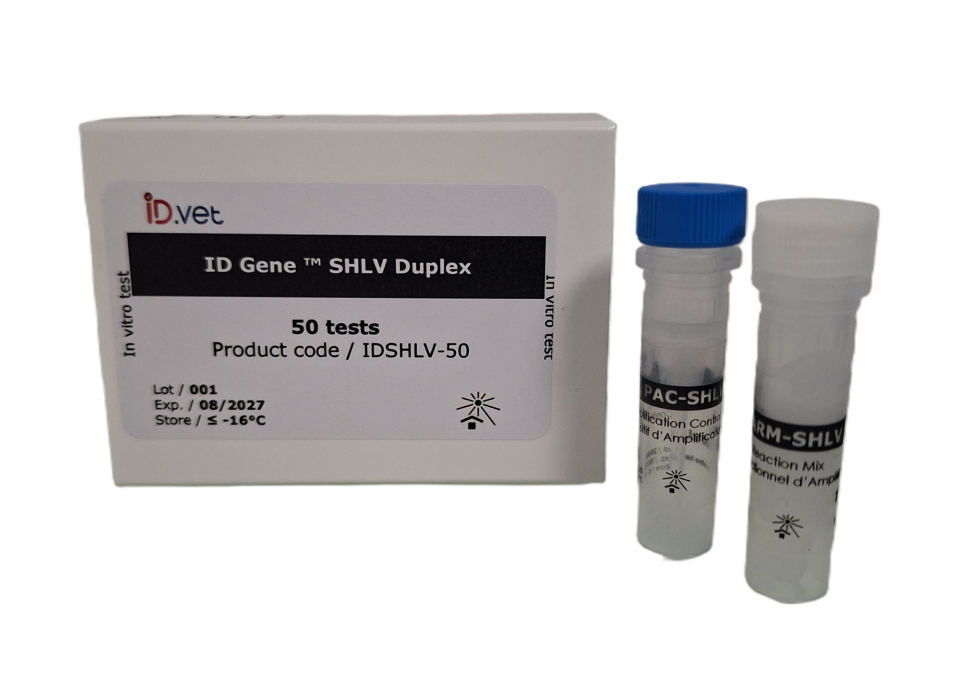
In response to this problem and the recent emergence of Shamonda-like virus 2026 (SHLV) in France, Switzerland, Germany, and other countries, our teams have developed the ID Gene™ SHLV Duplex kit for the qualitative detection of SHLV RNA in whole blood, serum, and organs and swab samples from ruminant abortion material.
The ID Gene™ SHLV Duplex kit has excellent specificity for differentiating Shamonda-like virus RNA from Schmallenberg virus and other orthobunyaviruses.
- High sensitivity, allowing for reliable detection even in samples with low viral loads
- A ruminant-specific endogenous control that allows monitoring of sample quality, as well as pretreatment and extraction steps.
Our ID Gene™ SHLV Duplex kit validates a wide variety of sample matrices, including whole blood, serum, and organs from abortion material (brain, placenta, spleen, and liver). Meeting our high standards of robustness and quality, its performance was thoroughly demonstrated in silico and in vitro using reference strains and field samples.
It was developed in collaboration with field laboratories and research institutes.
Reliable and rapid results for screening and confirming large volumes of samples, thanks to our trusted and user-friendly workflows.